|
|

|
|
|
|
|
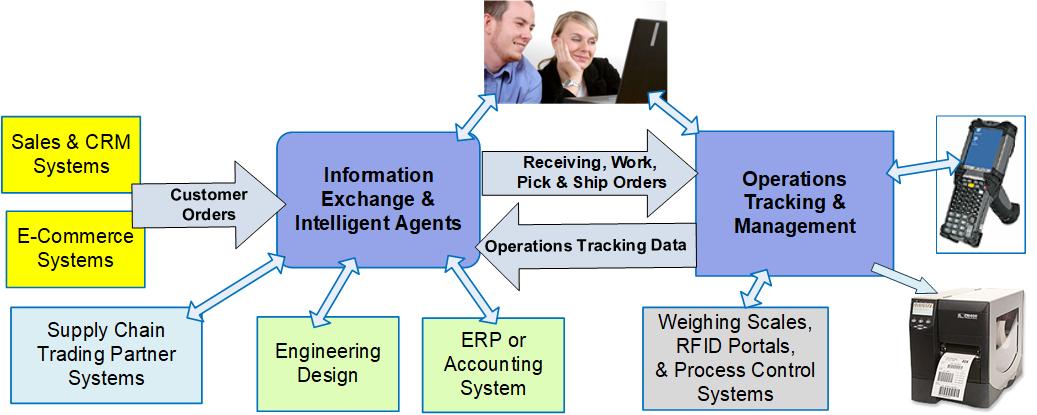
One of the most time-consuming jobs for a make-to-order manufacturer is converting customer orders into work orders to make products, purchase orders to buy needed materials and ship orders to ship the finished products.
Here ISOM intelligent agents can:
Depending on the products being shipped, these processes many be fully automated or may be performed in a collaborative decision support process with managers or their staff.
A critical part of this process is the ability of ISOM systems to predict future available inventory for each item based on current inventory, less demand from customer orders and planned work orders plus materials to be produced by planned work orders and materials expected to be received based on outstanding purchase orders. This predicted time varying function is tracked for every raw, intermediate and finished goods item managed by the ISOM system.
Orders are generated dynamically as the customer orders flow in. Resultant purchase, work, and shipping orders are then sent to the operations tracking subsystem and purchase orders are also sent to a purchasing system or directly to suppliers. Other orders may also be sent to ERP systems for historical record keeping.
The orders sent to the operations tracking sub-system are then used to control the flow of jobs and materials
through the manufacturing and shipping processes, with the resultant transactional data being sent back to an ERP system and supply chain partners if needed.
Please click here to learn more about ISOM Intelligent Agents.
Copyright © SmartOpsMgt LLC 2026