|
|

|
|
|
|
|
Many smaller manufacturing organizations, use the Profit and Loss statement from their accounting or ERP system to determine whether they made a profit or loss in the last accounting period, with no idea as to which jobs made money and lost money.
ERP systems enable a form of job costing in which the system records the labor expended on each work order and adds to this cost the standard cost of materials that should have been expended in making the product according to the product BOM (Bill of Materials).
This can result in very inaccurate job costing, as this ignores the cost of the actual materials used, including scrap. It also ignores the cost of equipment used, which today can be a very substantial part of the cost, with the increasing use of automation.
Most important, the labor hours recorded are reported based on post-facto numbers entered in time-sheets (cheat sheets) long after the work in completed, to make up 40 hours per week of work and so are often completely made up.
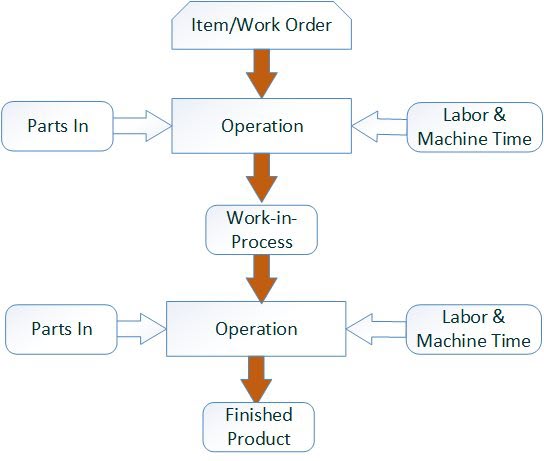
To get a true cost of each job, you need to use an ISOM system, in which the actual labor, materials consumed and produced, and machine time is recorded in real-time. An ISOM system will typically also record the setup and cleanup time for each operation as well as the work-in-process or finished products out of each operation.
In an ISOM system the route for making a product is broken down into a sequence of operations, with the expected materials to be consumed and produce for each operation, as well as the expected labor and equipment time for each operation. This is usually specified for each item to be made and then the quantities scaled for when a work order is created to make a specific quantity.
By recording the actual labor, materials and equipment time consumed in real-time, we are able to compute an accurate actual cost. Because an ISOM system tracks individual containers of material, this includes the actual cost of the materials consumed and not some approximate standard cost or a cost based on a FIFO approximation. It also includes the actual cost of scrap and wastage in the process and can account for different wage rates of employees.
We are then able to compare the actual cost against the estimated cost, which would have been achieved based on the work order, with standard costs for labor, materials, and equipment time on which, presumably, the bid for the job was based. In this way, we can see whether we made on lost money on each individual job.
Intelligent agents can also track the actual times and costs and, over time, use these to generate better estimates for jobs. This is especially true where there is often a short pre-production run followed by longer repeat jobs for the same customer.
Please click here to learn about ISOM vs ERP Systems.
Copyright © SmartOpsMgt LLC 2026