|
|

|
|
|
|
|
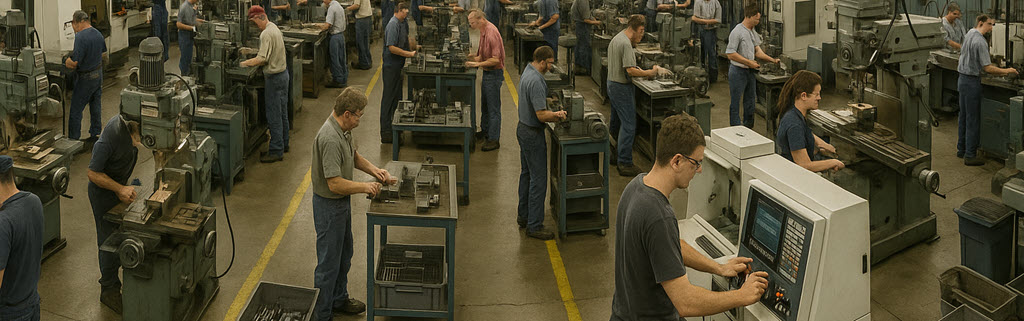
Manufacturing in the USA has changed significantly since circa 2000, also known as Y2K.
Around Y2K, I had a client that made products to stock based on a long run manufacturing model. They made a limited range of products, which they stored in a warehouse. They then shipped customer orders from stock and occasionally made more products when inventory in the warehouse ran low.
At that time this client had about 100 people on the floor and in the warehouse with about 20 people managing operations in the front office. Then China joined the WTO (World Trade Organization) in 2001 and started to flood the US Market with look-alike products, which they were able to make at lower cost because they had lower labor rates and were very good at manufacturing.
In response, this client just like most of the manufacturing plants in the USA, switched to make-to-order manufacturing, where they made small batches or individual products, on a quick turn-around basis, to take competitive advantage of the 6 weeks it takes for an ocean-freight container to get from China to the USA.
This was fortuitous because of the arrival of the “Amazon Effect”, whereby consumers and then businesses came to expect delivery of a vast array of products, ordered on-line, in a few days.
But by 2015 or so, the Chinese were starting to catch up in make-to-order manufacturing, especially for goods that could be air-freighted, and, as a result this client switched their shop-floor to highly automated machines, run by just 6 people, with 4 people in the warehouse to remain cost competitive.
At the same time, the front-office staff of this manufacturing plant had swelled to 32 people, managing just 10 people.
So, the problem, like for many other plants in the USA, became the overhead cost of people to manage their operations and also the resultant inefficiencies.
Along the way this organization had acquired an ERP system to try to improve the efficiency of their front office operations but found that their Enterprise Resource Planning system, like all other ERP systems, was basically designed around accounting and MRP (Materials Requirements Planning) algorithms for long-run manufacturing.
As a result, this increased rather than decreased the number of people needed in the front office. To solve this problem, this privately held plant sold out to a large overseas conglomerate, which closed the plant and moved the production elsewhere, mostly to Mexico.
Here, we suggest an alternate route, which is to use SmartOps24x7 technology to enable more efficient operations with a smaller number of “overhead” staff in the front office.
After all, the shop-floor was running very efficiently, producing more output to order than they had ever made before, with shop-floor labor being an insignificant part of their cost. But the front-office cost was making them non-competitive.
Please click here to learn more about Using Smart Operations Management methods to solve this type of problem.
| Recruiting | History | Company | Dr. Green |
Copyright © SmartOpsMgt LLC 2026